An artwork without its artist is decoration.
Milo says it champions artists. This is where the product keeps that promise: wherever a human work appears, a person can reach the work itself — the artist, the institution, the object number, the rights, the original file, and exactly what Milo did to it.
At rest · on interest · on request.
Not every screen is an art-history lesson. Step 1 is never optional; steps 2 and 3 are asked for.
The caption. Artist, work, date, institution. Always present, in the display serif with mono for the date.
Hover, focus or tap. Three actions, no more: the original, the artist, and why this image is here at all.
The full record as a level-3 panel: medium, dimensions, object id, rights, and the Milo recipe applied.
.art-record — opened from any caption action, dismissed with Escape.
Everything the manifest holds, reachable in one step.
This is a real record from assets/art/manifest.json and a real derivative from the shipped engine, not a mock-up.
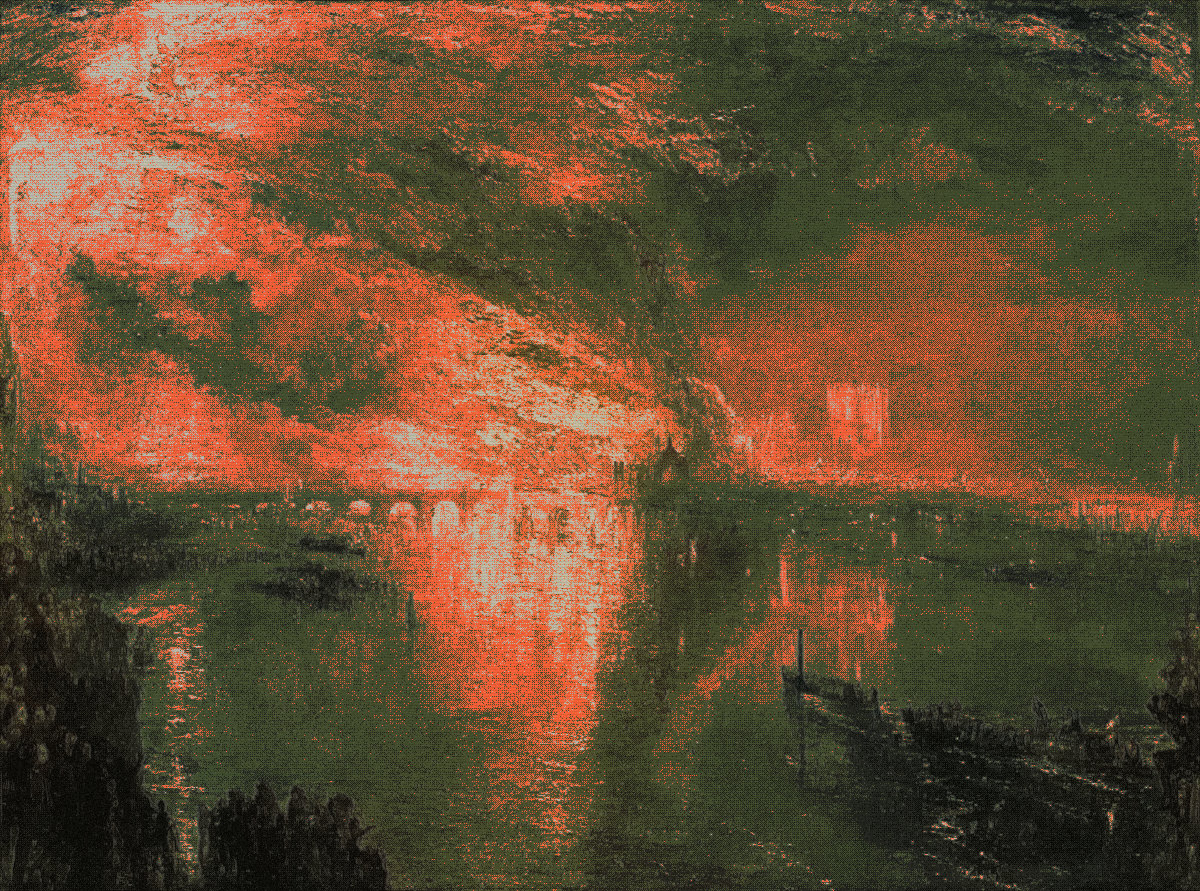
- Artist
- Joseph Mallord William Turner
- Date
- 1835
- Medium
- Oil on canvas
- Dimensions
- source file 3400 × 2525
- Institution
- The Cleveland Museum of Art
- Object id
- 1942.647
- Rights
- Public Domain (CC0) — CMA Open Access
- Source
- clevelandart.org/art/1942.647
- Treatment
- Milo / Nous · bayer4 · strength 0.90 · contrast 1.25 · 5 levels
- Engine
- milo-image-engine 1.0.0
Every field above comes from the manifest. If a field cannot be produced, the image does not ship.
Chosen for the fire and the river crowd: the first task this morning is a release that people will watch happen.
The .why-this line is the small honesty that makes art feel chosen rather than dressed on. Milo explains its own choice in one sentence, or it does not make one.
Three source kinds. Three marks. No ambiguity.
V1 made provenance a documentation standard. V1.1 makes it something a person can see at the point of use.
Artist · work · date · institution · rights. The record above.
■ filled square
The human record plus the transformation. Attribution is never replaced; it is appended to.
Never carries an artist’s name, never uses the archive recipe, never sits where it would read as a photograph.
Tone: clear without being punitive
Provenance is set in .image-metadata mono-micro at tertiary ink: legible, quiet, complete. It does not scold the viewer, does not shout GENERATED across the image, and does not interrupt work. One line at rest, the full record on request.
Provenance is a product capability, not a page in a manual.
Each surface has a minimum that ships with it.
| Surface | What must be visible |
|---|---|
| Any artwork or nature image | caption at rest — artist · work · date, or source · date |
| Design workspace | per artifact: human source credits, generation model and inputs, version lineage |
| Research workspace | every claim carries its source; an unsupported claim is drawn as unsupported, never hidden |
| Daily Bread workspace | scripture reference and translation; art credit; the source list before publish |
| Files and artifacts | where it came from: made by the person, produced by a run, or imported |
| Activity | which executor produced which artifact |
The six rules
- No image without a source record. If the record cannot be produced, the image does not ship.
- Transformation never erases attribution; it appends to it.
- Generated content is labelled at the point of use, not only in documentation.
- The original is always reachable in one step from the interpretation.
- Rights travel with the file — rights and rights_url are required fields.
- If a source's rights do not permit derivative work, no recipe may be applied to it.
python3 tools/validate_provenance.py